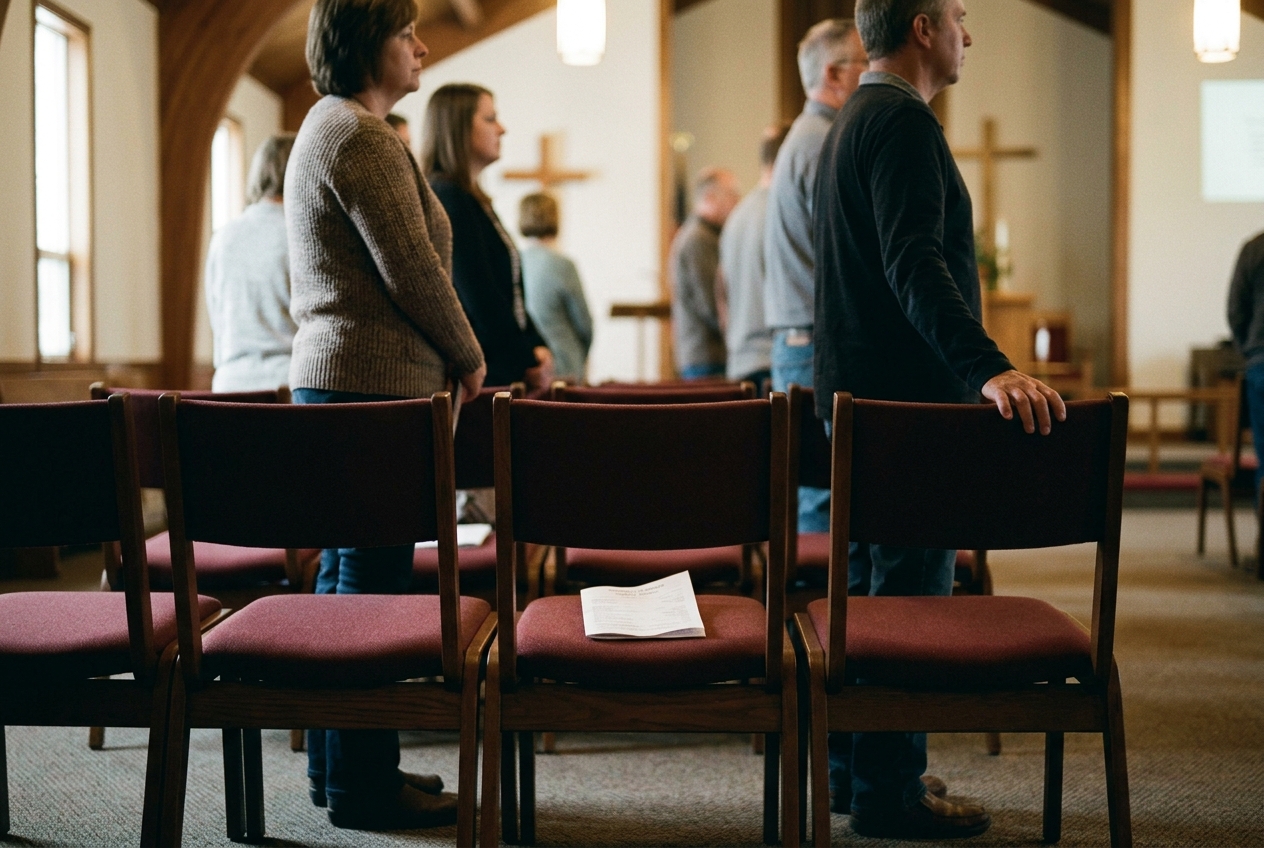
I once called a family after they'd missed about six weeks of church. Nice people, two kids, came faithfully for the better part of a year. The dad was kind on the phone, and about two minutes in he said the thing I still think about: "Honestly, pastor, we figured nobody noticed."
He wasn't bitter. That's what made it worse. He said it the way you'd report the weather. They'd missed a couple of Sundays back in the spring — sick kid, then a travel weekend — and when no one said anything, they ran a quiet little experiment without ever calling it that. Miss another week. See if anyone asks. Nobody asked.
By the time I called, I wasn't reaching out to a family that was drifting. I was calling the scene of something that had already happened a month earlier. They left in week two. The phone just didn't ring until week six.
Nobody leaves in one decision
We picture leaving as an event — a blowup, an offense, a moving truck. Those happen, and they're actually the easy ones, because you hear about them. The leaving that shrinks churches is the other kind, and it goes in stages.
Miss one Sunday: life. Everybody misses one. Miss two in a row: now there's a small, unspoken question — did anyone notice? They're not angry, they're not gone. They're listening. And the silence that comes back is an answer. Week three the sofa is easier, week four is a habit, and by the time somebody at church says "hey, I haven't seen the Carters lately," the Carters have quietly finished a conversation your church never knew it was in.
The brutal part: the person who calls at week six gets a pleasant conversation and an "oh, we've just been busy." The decision doesn't get unmade by then. It got made in the silence between week two and week three, and it was made by nobody deciding anything at all.
The lie: "we'd notice if someone stopped coming"
You'd notice a pillar. If your worship leader vanished, you'd notice by 9:40. But the family that's attended for two months? They don't sit in the same seat every week, they don't serve yet, and — this is the mechanism — everyone who might notice their absence assumes somebody closer to them already has. In a church small enough that "we'd notice" feels obviously true, absence has no owner. Noticing is everyone's job, which is the formal way of saying it's nobody's.
I stopped trusting my church's noticing the same week I stopped trusting my own memory for hospital visits, and for the same reason: love was never the missing ingredient. Attention is a system problem, whether the person is in a hospital bed or just quietly at home on the fourth Sunday in a row.
"We miss you" is a trigger, not a feeling
So here's the rule we run now, and it's almost embarrassingly simple: two missed Sundays triggers a contact. Not a feeling of concern. A trigger — somebody looks at who was expected and who showed, and when a name hits two absences with no known reason, a specific person gets asked to reach out that week. Sick kid? Travel? Great, now we know, and they know we asked. The experiment they were quietly running gets the other answer this time.
Two details matter more than they look like they should.
First, the contact comes from a friend, not from me. A pastor calling can't help feeling professional — it's my job to ask, and everybody knows it. A text from the woman who sits two rows back lands as being missed by an actual person. Send the friend; save the pastor for week five.
And second, the ask goes to a named person through the same kind of rotation we use for every other care need — because "somebody should check on the Carters" evaporates in a group chat exactly the way every group-text request evaporates. One name, one family, one week. If they can't do it, it moves to the next name by itself.
What it costs to be wrong here
Run the numbers on your own church, gently. If two families a year drift out the back door this way — and for most churches under 250 it's more — that's most of your growth for the year, erased in silence. We'll spend forty hours on an Easter service to reach new families and zero hours noticing the ones already in the building deciding whether they'd be missed. The math has never made sense to me since I saw it.
The fix costs a list, a trigger, and a rotation of friends willing to send a two-line text. We run ours through CarePilot — the "haven't seen in a while" need goes through the same never-dropped ladder as a surgery — but the trigger matters infinitely more than the tool. Start with a legal pad this Sunday. Just stop letting "we'd notice" go unchecked.
This is promise three of four from The Four Lies Keeping Your Church Small. The last one is about the people who stayed — and are still waiting to be asked: Nobody Volunteers Their Way Into Family.
Never find out in week six again.
CarePilot's "haven't seen" flow puts a gentle check-out in a friend's hands the moment someone's been quiet too long — through the same escalation ladder that's kept our dropped-needs count at zero.