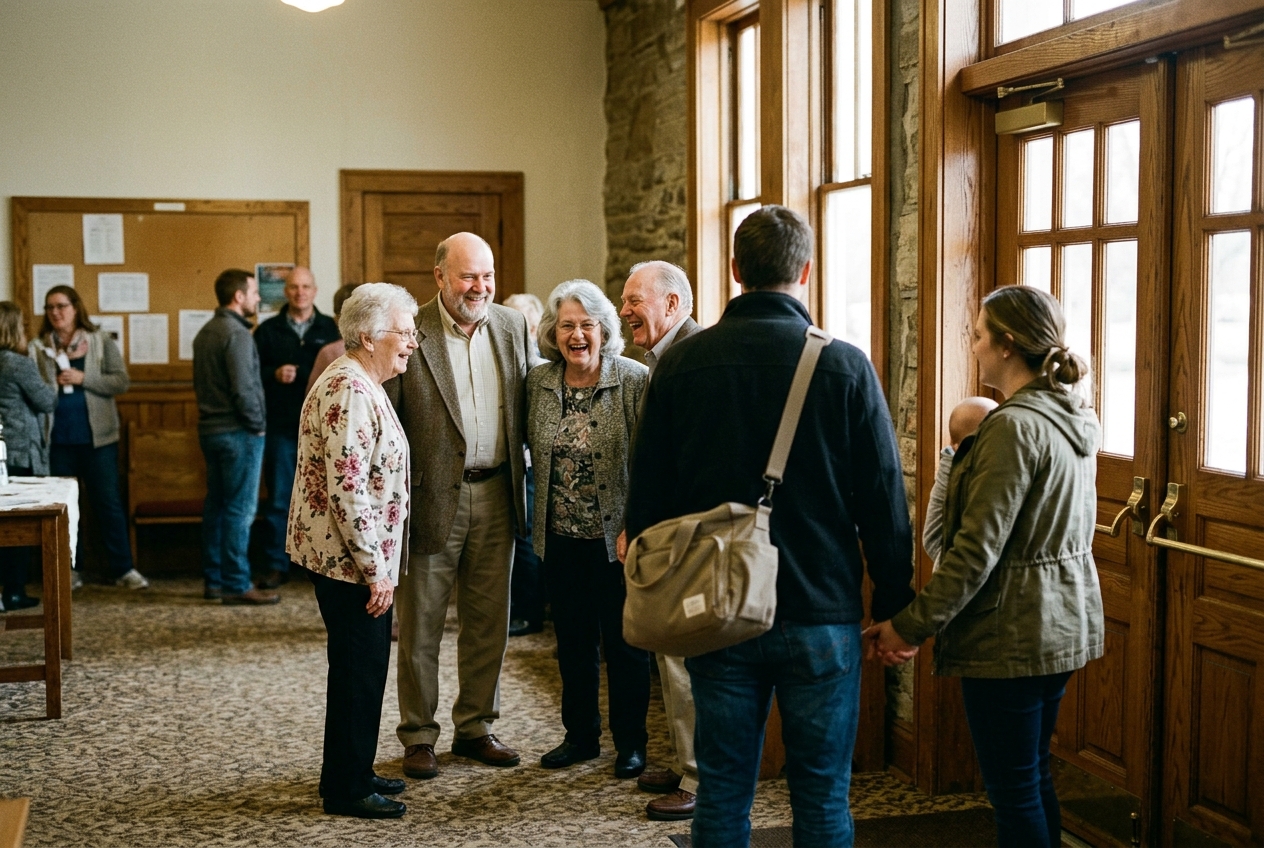
A few years back I asked a first-time guest, a young mom, how her Sunday with us went. She said, and I'm quoting her exactly: "Everyone seemed really close." It took me two days to hear what she'd actually said.
She didn't say people were kind to her. She said people were kind to each other, near her. She'd stood in our lobby holding a diaper bag for eleven minutes watching a family reunion she wasn't part of. We would have described that morning as friendly. She experienced it as a huddle. Both of us were right, and that's the problem.
Friendliness is a personality. Welcome is a system.
Here's the distinction that changed how we do Sunday mornings. Friendliness is what your church is like toward people it already loves. Welcome is what happens to a stranger, on purpose, because somebody was assigned to make it happen.
Those are different machines. The first one runs itself — you couldn't stop your people from hugging each other if you tried. The second one runs on assignments: named people, in named places, every week, whose whole job during those windows is the person nobody recognizes. If you don't have the second machine, you don't have welcome. You have warmth that guests get to watch.
And no, your greeter doesn't count. A handshake at the door is expected — even the DMV says hello. The moments that actually decide things are the unassigned ones: the lobby before service, and the five minutes after the last song, when your regulars snap into their circles like magnets and a guest discovers exactly how alone it's possible to feel in a room full of Christians.
Guests decide before the sermon starts
This is the part I most wish someone had told me earlier: by the time you stand up to preach, the decision about next Sunday is mostly made. Research on guest retention has said this for years, and honestly, think about your own behavior in a new restaurant. You know whether you're coming back before the food arrives. The kitchen just confirms it.
Which means the thing you spend twenty hours a week preparing gets less of a vote than the eleven minutes that young mom spent holding a diaper bag. I don't love that. It's still true. If you want to go deeper on why guests don't return — and why it's almost never the preaching — that's Why First-Time Guests Don't Come Back.
The stranger test
Want your real score instead of your reputation? Run this once. Ask somebody your congregation wouldn't recognize — a friend from another town, a pastor buddy's spouse — to come to church, arrive twelve minutes early, and do nothing. No introducing themselves, no wandering up to the welcome desk. Just stand where a normal guest would stand. One number: how many minutes before a person who isn't on staff and isn't assigned to a door speaks to them?
When we first ran it, our number was never. Not "seven minutes." Never. A church I'd have sworn was the warmest in the county let a stranger stand in the lobby through the whole pre-service window, and every single person who walked past her was busy being genuinely, sincerely friendly to somebody they already knew.
What we actually changed
The fix cost nothing, which is my favorite price. Three moves.
We drew zones. Lobby, sanctuary doors, parking to the front walk. Each zone has two named people each Sunday, and their assignment isn't "be friendly" — it's "nobody stands alone in your zone." Vague jobs don't get done; zones do.
We aimed the first five minutes after the last song. That window belongs to guests, and our zone people know it. The huddles can have the next fifty-five minutes. They were always going to happen — we just stopped letting them happen first.
And we made the handoff a rule: nobody gets welcomed by only one person. Whoever meets a guest walks them to somebody else and introduces them by name — which happens to be the start of the second promise, because a name that only one person knows is a name the church doesn't know. More on that in Only the Pastor Knows Their Name.
None of this requires software, a budget line, or a single volunteer you don't already have. It requires deciding that welcome is an assignment instead of an atmosphere. This post is the first of four promises I think every small church is making whether it means to or not — the map is in The Four Lies Keeping Your Church Small.
What happens after they fill out the card?
The welcome on Sunday is step one. GuestPilot runs the week that follows — the same-day text, the handwritten card, the invite back — so no guest ever slips through the follow-up crack either.